
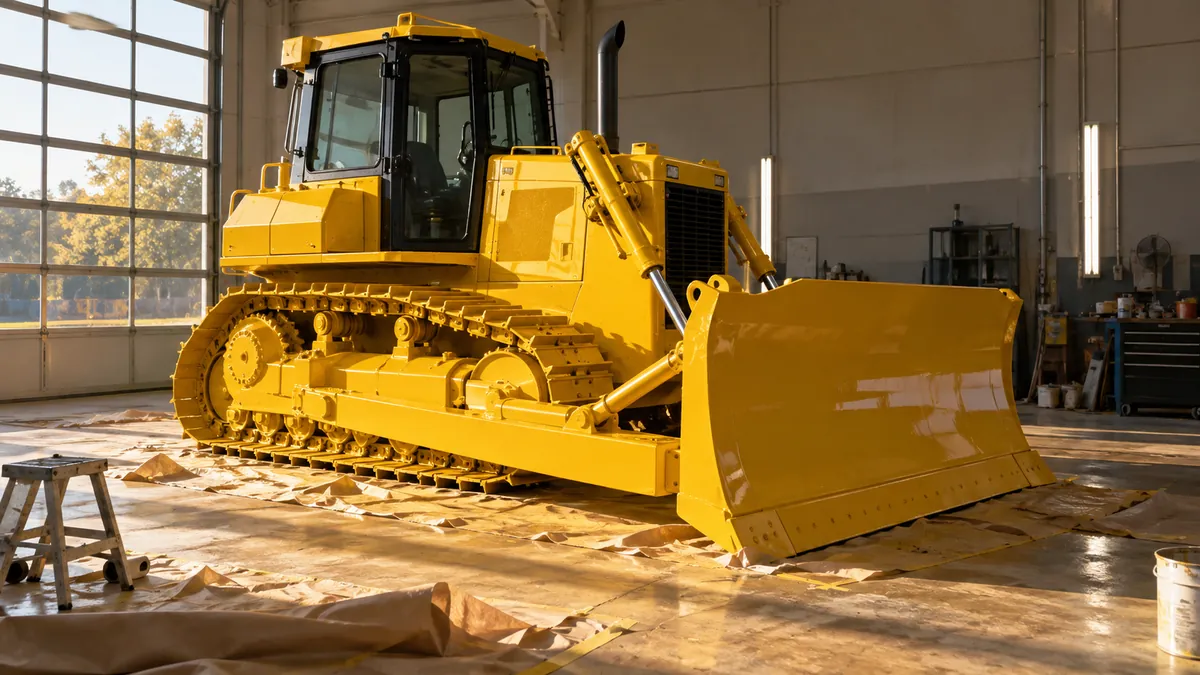
We paint equipment in a temperature-controlled shop
Marley Industrial Services sandblasts and repaints heavy and industrial equipment out of Fillmore. If a machine is too big to move, we do the work at your site.
Good equipment paint starts with clean steel
A machine that has worked a few seasons comes in carrying a lot more than paint. There is hydraulic oil around the fittings, grease packed along the pivots, and a film of dirt on everything below the frame. Primer will not stick to any of that, and blasting over grease only smears it across the steel. So the first step is a power wash and degrease, and then the machine has to dry out completely before anything else touches it.
Next comes abrasive blasting. It takes off rust and loose paint, and it leaves the steel with a rough texture that primer can grip. Paint sprayed over smooth, shiny metal sits on top and eventually peels. Before any grit flies, we cover what cannot take it: glass, rubber seals, hoses, gauges and machined surfaces like cylinder rods. A rod that picks up grit will tear up its seal the first time the cylinder moves. Then the machine leaks oil onto a fresh paint job.
Freshly blasted steel starts to rust again quickly in damp air. So primer goes on soon after blasting, before a thin orange film of new rust can form. That is one reason we do this work in a temperature-controlled shop. The primer and topcoat cure at a steady temperature instead of whatever the Illinois weather is doing that afternoon. For two-part coatings we use plural component spray equipment, which mixes the two parts at the gun in the correct ratio.
- Power wash and degrease before any blasting
- Abrasive blasting of rust and failing paint
- Glass, seals, hoses and rods masked off
- Primer and topcoat in our temperature-controlled shop
- Field painting for machines too big to move
Illinois weather is hard on equipment paint
Equipment around Fillmore spends much of its life outdoors, and central Illinois winters are rough on it. The temperature crosses freezing again and again, and every thaw lets water into any chip or crack in the paint. When it freezes, that water expands and pries the coating up a little further. Machines that travel between job sites on a trailer also pick up road salt. It packs into seams and brackets and keeps eating at the steel long after the snow melts.
Summer brings the opposite problem. On humid mornings dew forms on cold steel, and paint sprayed on a surface that is even slightly damp will blister or let go. The common rule in the trade is that steel should be at least five degrees Fahrenheit warmer than the dew point. It has to stay that way from the moment the coating goes on until it cures. In our shop we control that. Outdoors, the weather decides it.
Around Fillmore, a lot of equipment is kept in open pole barns, in steel machine sheds, or out on a gravel lot. A roof keeps the snow off, but an uninsulated steel shed sweats on cold mornings and drips that water onto whatever is parked underneath. Sun hitting one side of a machine every afternoon fades that side and turns it powdery first. The worn spots on a machine usually show how it was stored, and that helps us pick the coating that goes back on.
Some machines get painted where they sit
Not every piece of equipment can go on a trailer. Machines bolted to a floor, long conveyor runs and anything that would have to come apart to travel are usually painted in place. Marley Industrial Services works in the field as well as in the shop. The choice comes down to which setting gives that machine the better finish, and how long the owner can have it out of service.
Field painting takes more setup than shop work. Floors, walls and anything parked nearby have to be protected from blast grit and overspray, because both travel farther than people expect. Blasting and priming are planned together, so freshly blasted steel gets primer before the evening dew settles on it. If the wind picks up or the steel cools toward the dew point, spraying stops for the day.
Rushed field jobs are easy to spot a few months later. Paint sprayed into a breeze dries before it lands and goes on rough and thin. A coating sprayed late in the day, as the air cools, can stay soft for days and pick up all the dust that blows past it. A good field finish looks close to a shop finish, and getting there mostly means waiting for the right conditions.
Where a machine works decides the coating
A loader that sits in a gravel yard and a machine that runs inside a clean plant need different paint. Equipment that sits out in the weather or gets splashed with fuel usually gets a two-part industrial coating. It cures harder than a single-part enamel and holds up better to washdowns. A machine that lives indoors may not need that. Before a coating is picked, we ask where the machine works and how it gets cleaned.
Some jobs arrive with a written paint specification. It names the primer, the topcoat and how thick each coat has to be. Paperwork often goes back to the owner when the work is done. That work moves slower, because each step gets checked against the spec before the next one starts. Robb Spear left a Google review after a job like that, a piece of equipment with a complex paint and documentation process. The review reads: "Very high quality work, very professional, on time and clear communication."
Color gets settled before the topcoat goes on. Some owners want a machine back in its original factory color, and others want it to match the rest of their equipment. A finish done right has even color from panel to panel and no runs hanging under the frame rails. Paint pulls thin on sharp edges and welds, which is where rust comes back first. So those get an extra coat by brush or gun before the full coat goes over them.
Get a free equipment painting quote
Call (217) 538-2025 Monday to Friday, 8:00 AM to 5:00 PM, and tell us what the machine is and where it sits.
What 4 homeowners said
Every quote below is a real review, word for word, from our Google profile.
I had a large job painting a piece of equipment with a complex paint and documentation process, and Marley Industrial Services absolutely knocked it out of the park!! Very high quality work, very professional, on time and clear communication. Highly recommended!!
Great company family owned, there services are top notch I would highly recommend them to anyone looking to get anything painted!
Call now for a free painting quote
No. We paint in our temperature-controlled shop in Fillmore when a machine can be hauled in, and we work in the field when it cannot. The shop usually gives the better finish, so it is the first choice when moving the equipment is practical.
That depends on what is under it. Paint that is still well stuck can be cleaned and recoated, but rust and flaking paint have to come off by abrasive blasting. Paint sprayed over rust keeps rusting underneath and lifts again.
Anything that grit or paint could damage. That means glass, rubber seals, hoses, gauges and smooth metal parts like cylinder rods. If grit stays on a cylinder rod, it can wreck the seal the first time the cylinder moves. So we wrap those parts with care.
Yes. Some equipment jobs come with a required coating system and paperwork, and we work to the spec one step at a time. One of our Google reviews, from Robb Spear, describes a job like that.
In our temperature-controlled shop, yes, because the coating cures at a steady temperature whatever the weather is doing outside. Outdoors, the steel has to stay warmer than the dew point while the paint goes on and cures. So field work gets scheduled around the forecast.
Call (217) 538-2025, Monday to Friday, 8:00 AM to 5:00 PM. Estimates are free. Tell us what the machine is and whether it can come to Fillmore, since that decides if it is a shop job or a field job.
Tell us what needs painting.
Call us or send a request, and we will set up an estimate for your job.
- Monday to Friday8:00 AM to 5:00 PM
- Saturday to SundayClosed