
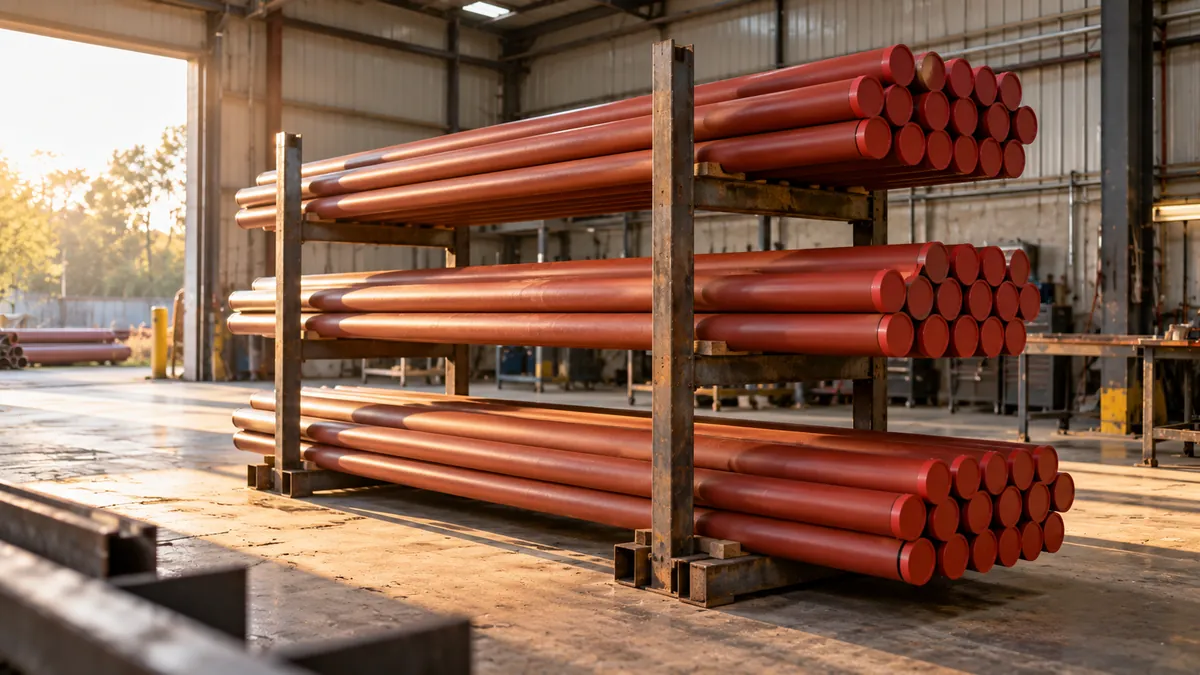
We blast pipe to bare steel first
Then we prime and coat it in our temperature controlled paint shop in Fillmore, or on site when the pipe is already installed. Marley Industrial Services is women owned and rated 5.0 from 4 Google reviews.
Pipe coating follows a set order
Pipe coating follows the same order on every job, and each step depends on the one before it. First we look the pipe over and wash off any oil and grease, because blasting over grease drives it into the steel instead of removing it. Then the pipe is abrasive blasted until the old rust and mill scale are gone and the metal is a dull, even gray. That clean, rough surface is what the primer grabs onto.
Primer goes on before the bare steel has time to rust again. Blasted steel left sitting in humid air can turn orange overnight, and coating over that thin rust means coating over a weak layer. Next we brush an extra coat by hand onto the welds and flange edges. A spray coat pulls thin over a sharp edge, and those edges are where rust on a pipe nearly always starts.
Then the full coats go on, and the pipe cures before anyone handles it. A coating can feel dry to the touch long before it is hard. A chain or strap will scuff a soft coating right down to the primer. When a job comes with a written coating spec and paperwork, we follow the spec step by step and keep the records. The pipe that leaves here has an even coat with no runs or bare spots.
- Wash to take off oil and grease
- Abrasive blasting down to clean bare steel
- Primer on before the steel can rust
- Extra coat brushed onto welds and edges
- Full coats cured before the pipe moves
Illinois weather is hard on pipe
Central Illinois puts pipe through a lot in a single year. Summers are hot and humid, so a pipe carrying cold water sweats all afternoon and the underside stays damp for weeks. Winters freeze and thaw over and over. Any water that gets under a coating freezes and pushes it up a little more each time, until a flake lets go and bare steel shows.
On a pipe run, rust rarely starts in the middle of a straight length. Look first where the pipe rests on a support, because water sits in that joint and the pipe rubs against it as it warms and cools. Threaded ends and flanges come next, since the steel there is cut and the coating tends to be thin. Pipe under wet insulation can rust for years before anyone sees it.
Unheated steel buildings add their own problem. Around Fillmore, a lot of pipe runs through machine sheds and grain facilities that sit cold all winter. On a warm spring morning, moist air hits that cold steel and water beads up on every pipe and beam. A coating that went on thin, or went on over rust, starts failing at those wet spots first.
Pipe coated in our shop cures evenly
Marley Industrial Services has a temperature controlled paint shop in Fillmore, and it matters more for pipe than most people expect. Most industrial coatings need the steel above a minimum temperature to cure right. They also need the steel a few degrees warmer than the dew point, or a thin film of water forms under the coat. In an Illinois winter, outdoor steel can miss both marks for weeks at a time.
Inside the shop, the temperature holds steady from the first coat through the final cure. That means every coat on the pipe goes on under the same conditions, and none of them gets rushed by the weather. For two part coatings, we use plural component spray equipment, which mixes the two parts as it sprays. That keeps the mix the same from the first length of pipe to the last.
Shop work also gives us control over how the pipe is handled. Loose pipe and fabricated steel pieces can be set up so the coating reaches all the way around. That includes the bottom side, which would sit on the ground in the field. The pipe stays under a roof until the coating is hard. Then it goes back on the truck without chain marks or scuffed spots.
We also coat pipe where it sits
Some pipe cannot come to the shop because it is bolted into a building or runs along a plant wall. For those jobs we work on site. Field work follows the same order as shop work: clean, blast or strip, prime, brush the edges, then the full coats. What changes is that we have to plan each coat around the weather instead of a thermostat.
In the field we watch the steel temperature and the dew point through the day, not just the forecast. Shaded pipe can stay wet with dew long after the sun is up. Where blasting dust is a problem, such as inside a plant that is still running, water jetting can strip the old coating instead. We cover whatever sits near the pipe so nothing else gets hit.
Structural steel gets the same care on site. Beams and columns in a steel building usually rust first at the base, where the steel meets concrete and water collects. We clean and coat those spots first, because a good coat higher up does nothing if the base keeps rusting. Around Fillmore, Nokomis, Hillsboro and Vandalia, a lot of that steel holds up farm buildings and small plants.
Skipped prep steps show up as rust
New pipe looks clean, but it is not ready to paint. Black steel pipe comes from the mill with a blue gray skin on it called mill scale. Paint sticks to that skin well enough at first. Then the scale cracks away from the steel as the pipe heats and cools, and it takes the coating with it in patches. That is why new pipe gets blasted too.
Painting over rust at the threads or flanges is the other common shortcut. The new coat hides the rust for a season, but the rust keeps growing underneath and pushes the paint up in blisters. Coating a pipe while it is sweating does the same damage faster. The coat traps a film of water against the steel, and rust starts under a coat that still looks brand new.
The fix for all of this is time spent before any paint comes out. On most pipe jobs the prep takes longer than the painting, and it should. Be careful with a pipe coating quote that never asks whether the pipe sweats or how it will be prepped. That estimate is missing the part that decides how long the coating lasts.
Get your free pipe coating estimate
Call (217) 538-2025 and tell us what the pipe carries and where it runs, and we will set up your free estimate.
What 4 homeowners said
Every quote below is a real review, word for word, from our Google profile.
I had a large job painting a piece of equipment with a complex paint and documentation process, and Marley Industrial Services absolutely knocked it out of the park!! Very high quality work, very professional, on time and clear communication. Highly recommended!!
Great company family owned, there services are top notch I would highly recommend them to anyone looking to get anything painted!
Call now for a free painting quote
Both. We coat pipe in our temperature controlled paint shop in Fillmore, and we also work on site when the pipe is already installed. The shop gives us more control over temperature and curing, so pipe that can travel is best coated here.
Blasting removes rust and mill scale and leaves a rough surface the primer can grip. Paint over rust or mill scale is only as strong as that loose layer underneath. When the layer lets go, the coating comes off with it.
Yes. New black steel pipe carries mill scale from the mill, and coatings put straight onto mill scale tend to flake off in patches. Blasting it off first gives the coating bare steel to hold onto.
Yes, but the pipe has to be dry and warmer than the dew point while the coating goes on and cures. On site that can mean draining the line or waiting for drier weather. If the pipe can come out, coating it in our temperature controlled shop avoids the problem.
Yes. We blast and coat structural steel such as beams and columns, and it follows the same order we use on pipe. The base of a column gets extra attention, because that is where water collects and rust starts.
Yes. When a job comes with a written coating spec, we follow it step by step and keep the records it asks for. One Google reviewer, Robb Spear, hired us for a job with "a complex paint and documentation process" and left five stars.
Tell us what needs painting.
Call us or send a request, and we will set up an estimate for your job.
- Monday to Friday8:00 AM to 5:00 PM
- Saturday to SundayClosed