
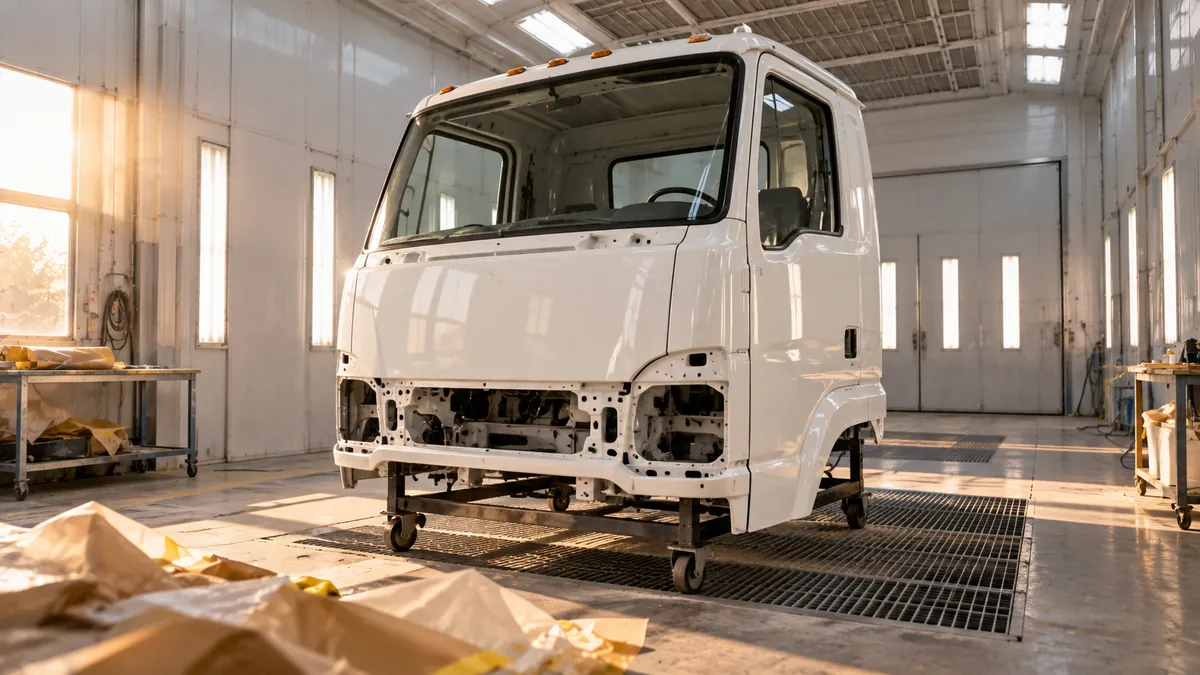
We blast the rust off before painting
We paint work trucks and trailers in our temperature controlled shop in Fillmore, and on site when a job calls for it. Marley Industrial Services is woman owned, with 5.0 from 4 Google reviews.
Road salt rusts truck frames from underneath
Illinois roads get salted all winter, and on the highways a lot of it goes down wet, as brine, so it clings. The tires throw it up into the frame rails, the crossmembers, the backs of the fenders and the seams of the bed. It stays there long after the snow melts. The doors and hood on a work truck can look fine while the frame under them is flaking apart. That is why we start every truck job underneath.
Rust on a frame spreads under the paint where you cannot see it. By the time a blister shows up, the steel beneath it has been rusting for a while. Painting over that seals the salt and moisture against the metal, and the new coat starts lifting within a season or two. So the rust has to come out before any paint goes on. We wash the salt off first, then blast the rusted areas back to clean, bright steel.
Around Fillmore, a lot of the trucks on the road are working trucks: farm trucks, grain trailers, flatbeds and service trucks. They run gravel roads and spend nights parked outside or in an unheated pole barn. Gravel chips the paint on the lower panels and along the front of a trailer, and every chip gives rust a new place to start. A finish on a truck like that has to hold up to rocks and water, and we prep it with that in mind.
- Power wash and degrease before blasting
- Rust blasted down to clean steel
- Lights, glass, tires and chrome masked off
- Primer on before fresh rust can form
- Painted in our temperature controlled shop
Prep decides how long truck paint lasts
A truck job starts with a wash. We power wash the frame and the underside of the bed until the mud and road salt are gone. Anything with oil or hydraulic fluid on it gets degreased. Grease left on the steel gets driven into the surface by the blast, and paint will not stick to it. Then everything that should stay unpainted gets masked off: lights, glass, tires, gauges, hoses and any chrome.
Next comes the blasting. On a frame or a trailer deck, we want steel with no rust left in the pits. The surface should come out slightly rough so the primer has something to grip. Blasting also shows what the rust was hiding. Sometimes a crossmember or bed floor is thinner than it looked, and it is better to find that now than after painting. When the metal needs repair, we show you before we go any further.
Bare steel starts to rust again quickly, especially on a humid Illinois day. So primer goes on soon after blasting, before a thin orange haze can form on the metal. Skip that step and you have painted over fresh rust, and the job is failing before the truck leaves the shop. Once the primer is down, the color coats go on. For the hardest working trucks we spray two part coatings that mix with their hardener right at the spray gun.
Cold weather stops truck paint from hardening
Most industrial coatings harden through a chemical reaction, and that reaction slows way down in the cold. Spray a truck in an unheated barn in an Illinois January and the paint can stay soft for days while dust settles into it. It may look fine when the truck rolls out, then chip the first time a chain or a load gets dragged across it. The finish never got as hard as it was meant to.
Humidity causes the other half of the trouble. Summers here are hot and sticky, and moisture in the air can get trapped in a wet coating. A lot of trucks around here are parked in steel pole barns and machine sheds. On a cool morning, those buildings sweat, and so does every truck parked inside. Paint that goes on over that thin film of water lets go later, usually in patches.
That is why we paint trucks in our temperature controlled shop. The truck comes inside and the steel warms up to shop temperature before any coating goes on. Then the paint hardens in air we control, and the truck stays inside until it is hard enough to handle. When a job has to be done on site, we do field work too, and we plan it around the weather.
Trailers rust first at the seams
A trailer rides low behind the truck pulling it, so it catches the salt spray and gravel that the tires throw back. The rust starts where two pieces of steel meet: along the crossmembers, under the deck boards, around the fenders and at the tongue. Water sits in those joints. In winter it freezes and swells, and every cold snap pries the paint open a little more. The rust works outward from inside the seam.
Those joints are also the hardest part of a trailer to prep. The blast has to reach the corners and the back of every crossmember, along with the faces you can see. Those hidden faces are where a quick paint job misses, and they are where rust comes back first. We work a trailer from underneath, the same way we work a truck frame. It takes longer, and it is the part that decides how many winters the paint lasts.
What a trailer hauls matters too. Fertilizer and manure are both hard on steel, and a farm or livestock trailer that carries them needs a coating that can take it. It also has to hold up to being washed out over and over without the paint lifting. Tell us what the trailer carries and how you clean it, and we will match the prep and the coating to that.
Need a truck or trailer painted?
Call (217) 538-2025, tell us about the truck or trailer, and we will look it over and give you a free estimate.
What 4 homeowners said
Every quote below is a real review, word for word, from our Google profile.
I had a large job painting a piece of equipment with a complex paint and documentation process, and Marley Industrial Services absolutely knocked it out of the park!! Very high quality work, very professional, on time and clear communication. Highly recommended!!
Great company family owned, there services are top notch I would highly recommend them to anyone looking to get anything painted!
Call now for a free painting quote
Yes. A lot of work trucks only need the frame and the underside of the bed done, because that is where the rust is. We look the truck over and tell you what actually needs work.
Yes. We blast and paint trailer frames, decks, fenders and tongues, and we spend extra time on the seams and crossmembers where trailers rust first. Tell us what the trailer hauls so we can pick a coating that holds up to it.
A wire brush polishes the top of the rust and leaves the rest down in the pits of the steel. Paint over that and the rust keeps growing underneath. Blasting takes it out down to clean metal, so the primer sticks to steel instead of rust.
Yes. We paint trucks and trailers in our temperature controlled shop in Fillmore, so the coating hardens properly even when it is cold outside. Paint sprayed in an unheated barn in winter often stays soft and fails early.
Most truck and trailer work turns out best in our shop, where we control the temperature. We also do field work on site when a job calls for it, so call and tell us what you have.
Call (217) 538-2025, Monday to Friday, 8:00 AM to 5:00 PM. Estimates are free. Tell us what you have and where the rust is, and we will set up a time to look at it.
Tell us what needs painting.
Call us or send a request, and we will set up an estimate for your job.
- Monday to Friday8:00 AM to 5:00 PM
- Saturday to SundayClosed